- Over 7,000jobs completed
- 5.0from 130+ Google reviews
- SERMI approvedDBS checked and fully insured
- 12 month warrantyon every key
The two radio links inside one key fob
Press a button and the fob transmits. Walk up to a keyless car and the car transmits instead, reaching out on a low frequency inductive field to wake the fob and decide whether it is close enough to count. Those are two different links at two very different frequencies, and shielding behaves differently on each.
Relay theft exploits the second one. That is why the distinction below is worth understanding before buying anything.
The transmitting half is also the half that is paired to the car, and pairing it again is remote key programming rather than a repair to the case.
| Link | Direction | What it is used for |
|---|---|---|
| 433.92 MHz, inside the licence exempt 433.05 to 434.79 MHz band | Fob to car | Locking and unlocking from the button |
| 868 MHz, inside the 863 to 870 MHz band | Fob to car | A second allocated band used by some systems |
| About 125 kHz, a low frequency inductive field | Car to fob | Waking the fob so a keyless car can judge whether it is nearby |
A wrap that silences the button does not silence the inductive link the car uses, and the next two sections turn on that difference.
Materials that block and materials that do not
A material blocks a radio signal when it conducts. Everything else is decoration.
- Aluminium. Works, and it is one of the metals used to line purpose made signal blocking pouches.
- Copper and nickel. Work, and both appear as pouch linings because they hold up better in use than cheaper metals.
- Steel. Works as the body of a tin or a box, provided the lid closes metal to metal all the way round.
- Aluminium foil. Works when it is wrapped in two or three layers with no gaps, and fails the moment there is a crease, a tear or an open seam.
- Fabric, leather, plastic, wood, card and foam. Block nothing. There are no mobile charges in them to cancel the field, which is why a leather key case and a closed glovebox do nothing whatsoever.
- Metal effect finishes. A painted, anodised or printed metallic surface over a plastic body carries no current and shields nothing.
The gap decides it, not the thickness
The longest dimension of an opening governs how much escapes through it, and the area of the opening does not. Power leaking through seams and apertures outweighs power passing through the walls of an enclosure, and a single breach removes the benefit of the whole thing. Measured enclosures have returned around 14 decibels of shielding where the material on its own predicted well over 100, and the difference is entirely the holes.
Thickness buys less than people expect. Reflection loss, which is the signal bounced off the surface, does not depend on thickness at all. Only absorption does. At the frequency the fob transmits on, ordinary kitchen foil is several skin depths thick and absorbs a great deal. At the much lower frequency the car uses to wake the fob, that same foil is a fraction of one skin depth and absorbs next to nothing.
Engineered enclosures solve this with gaskets and contact springs that create a conductive join right around every edge, cover and door. A biscuit tin has none of that, which is the whole reason a tin underperforms a pouch.
Why a button test proves only half of it
Wrap a fob, stand at the car, press the button and get nothing. That proves the higher frequency transmission is blocked. It does not prove the lower frequency link is blocked, and that is the one a relay attack uses.
Shielding is weaker down there for two reasons. Close to a magnetic source the reflection term falls away, so the work has to be done by absorption, which needs thickness a thin lining does not have. Openings also degrade magnetic shielding more than electric shielding. Test anyway, because a container that fails the button test has already failed, but read a pass as encouraging rather than conclusive.
- Put the key in the pouch or container and close it fully.
- Carry it to the car and press lock and then unlock.
- On a keyless car, pull the door handle and then try the start button with the key still shut inside.
- Move the key to a different position inside the container and repeat, because a few millimetres of movement changes the result.
- Any response from the car at all means it leaks, and that container is not a storage place for that key.
- Repeat the whole test every few months, which is the interval police guidance gives for signal blocking storage.
What the measurements say about each option
Independent bench testing of phone sized containers gives a clear ranking, even though the frequencies tested sit above car key frequencies.
| Container | Measured attenuation, 1 to 6 GHz | What it tells you |
|---|---|---|
| Purpose made signal blocking pouch | About 89 to 111 decibels | The strongest of the group and consistent across the range |
| Metal biscuit tin | About 29 to 44 decibels | Far weaker, and the reading shifts by several decibels when the key moves a few millimetres |
| Carefully wrapped aluminium foil | About 50 to 90 decibels, attempt to attempt | Capable in principle and it never repeats, and opening it destroys the wrap |
| Mylar or antistatic bag | Under 9 decibels | No use for this at all |
Those readings were taken from 1 to 6 GHz rather than at car key frequencies, so treat them as a ranking of build quality and continuity rather than as performance figures against a fob.
What to buy and what it does not cover
Choose a pouch lined with a continuous conductive mesh in silver, nickel or copper, and treat a cheap lining as a short term purchase, because thin metals wear faster. The documented failure modes are ordinary wear, a closure that no longer seals, physical damage, moisture and corrosion, and folding and rubbing in daily use damaging the lining from the inside.
Shielding also has a boundary. A pouch stops a relay attack reaching the key, and it does nothing about a diagnostic port used to unlock and start a vehicle, signals injected into the car network, a device that emulates a key, a jammed lock signal that leaves the car unlocked, or somebody who walks into the house and picks the keys up. Storage location and physical security carry those, not the material.
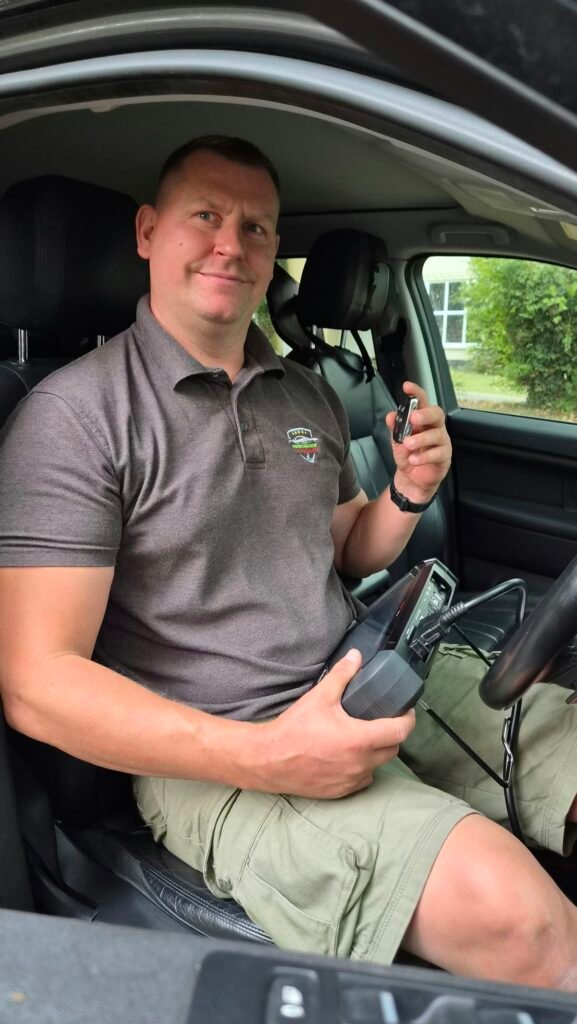
Who Wrote This
Darius is the owner of Herts Car Keys and the locksmith on every job. He has six years in the trade and has completed over 7,000 car key and lockout jobs.
He is approved under the SERMI scheme, DBS checked and fully insured, and every key he supplies carries a 12 month warranty.
Car Keys Made at Your Vehicle
Call Darius with the registration and the model year.