- Over 7,000jobs completed
- 5.0from 130+ Google reviews
- SERMI approvedDBS checked and fully insured
- 12 month warrantyon every key
Why the front of the house is the problem
A relay attack breaks nothing. The car is constantly asking whether its key is nearby, the key answers honestly, and a pair of devices simply carries that exchange across the front wall. No code is copied, no encryption is broken, and the car is left with no sign of forced entry, which also complicates the insurance claim afterwards.
The numbers put the risk exactly where the key sits overnight.
| Measure | Year to March 2025 | What it means for key storage |
|---|---|---|
| Thefts of vehicles in the evening or at night | 75.3 per cent | The overnight hours are the window that key position governs |
| Thefts of vehicles in darkness | 71.7 per cent | Lighting over the parking space earns its place |
| At the home, semi private area such as a drive or shared parking | 37.3 per cent | Driveways are the main scene, not car parks in town |
| At the home, on the street outside | 16.1 per cent | Kerbside parking outside the house adds to the same total |
| At the home, private area | 13.6 per cent | A private space is no exemption |
| Signal relayed from a remote locking device | About 47 per cent | The largest single entry method for thefts of whole cars |
Those first three home categories together put around two thirds of car thefts at or immediately around the owner address, overnight. The relay share comes from a survey with a small sample of incidents, so read it as the level rather than as a movement from year to year.
The places to move keys away from
The right answer is as much about where the keys are not as where they are. Every item below is either within relay range of the street or within reach of a hand.
- The hall table and the shelf by the door. The closest point in the house to the street, and the one spot a letterbox can reach.
- Any windowsill. Glass attenuates nothing, and the key is sitting against the outer wall.
- A hook in the porch or on an outside wall. That is outside the house entirely.
- The car itself, including the glovebox. Insurers treat the location of the keys as material to a theft claim, and a key left in the vehicle is the simplest theft there is.
- The fridge or the microwave. Not a storage place for a car key, and the microwave adds a hazard of its own.
- The spare key drawer everyone forgets. Police guidance includes the spare by name, and a protected first key with an unprotected spare in the hall protects nothing.
A pouch works and it has a service life
A signal blocking pouch is a conductive mesh lining in silver, nickel or copper wrapped around the key. The documented failure modes are ordinary wear and tear, a closure that no longer seals, physical damage, moisture and corrosion, and cheap linings wearing out faster than better ones. Daily folding and rubbing damages the lining from the inside, where you cannot see it.
This is why both police guidance and vehicle security guidance tell owners to retest rather than to trust the pouch, and why the published retest interval is every few months rather than never.
- Put the main key and the spare in their pouches and close both fully.
- Walk to the car and press lock, then unlock.
- Pull the door handle and try the start button with the key still inside the pouch.
- Any response at all means that pouch is finished, and it gets replaced rather than repaired.
- Put the retest in the calendar every few months, and run it again after the pouch has been sat on, soaked or dropped.
- Note the limit of the test. It proves the button frequency is blocked and not the lower frequency link the car uses to wake the fob.
A pouch does not cover the other attacks
Shielding answers one route in and leaves several open, so it belongs alongside the rest rather than instead of them. A diagnostic port can be used to unlock and start some vehicles, signals can be injected into the car network, a device can emulate a key outright, and a jammed lock signal can leave the car unlocked after you have walked away from it.
Then there is the oldest route of all. Car keys were taken in 8 per cent of domestic burglaries with entry where anything was stolen in the year to March 2025, nearly 59 per cent of burglars entered at the front of the property, and 67 per cent of those burglaries happened in darkness. A fabric pouch on the hall table answers none of that, which is the real argument for moving the keys upstairs rather than simply bagging them.
Where keys are taken from inside the house overnight, the car is left answering a key somebody else holds, and an emergency auto locksmith deletes that key from the vehicle at any hour.
What else reduces the risk overnight
Each of these is in police or vehicle security guidance, and each one covers a route a pouch does not.
- Turn the fob off where the car allows it. The handbook states whether the keyless function can be deactivated at night, and that is the one measure that removes the relay target entirely.
- Fit a physical lock. Police guidance names steering wheel locks, pedal boxes and gear stick locks as products that stop a car being driven away after a thief has got into it, and the higher tested grades resist a hand held angle grinder.
- Use the garage, or the tightest spot you have. Park in a locked garage where there is one, and as close to the property as possible where there is not.
- Block the better car in. With two vehicles on a drive, park the less desirable one across the other.
- Fit a lockable cover over the diagnostic port. Police guidance names the port as a route used to unlock and start some vehicles.
- Check the car actually locked before walking away. A jamming device blocks the lock command, and the only defence is to try the handle.
- Have a lost or unaccounted key deleted. Reprogramming through an approved auto locksmith erases the pairing between an old key and the car, so a key you do not control stops working.
Where a motion sensing fob leaves you
Some fobs sense movement and go quiet when they have been still for a while, which stops a relay attack once they are asleep. That is a timer, not immunity. The car is exposed for the whole window between being parked and the fob going quiet, and vehicle testing bodies have asked for shutdown inside five minutes precisely because not every maker keeps that window short.
Ultra wideband keys are the stronger answer, because the car measures the travel time of the signal and a relayed conversation fails the distance check. That is a property of the vehicle rather than something you add at home, so it belongs on the list of things to ask about when buying rather than tonight.
Who Wrote This
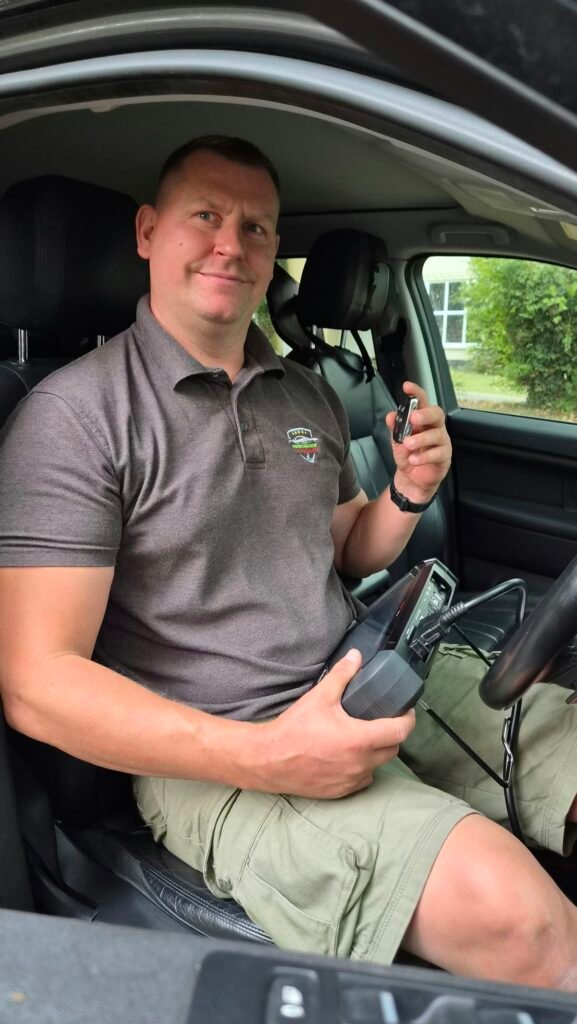
Darius is the owner of Herts Car Keys and the locksmith on every job. He has six years in the trade and has completed over 7,000 car key and lockout jobs.
He is approved under the SERMI scheme, DBS checked and fully insured, and every key he supplies carries a 12 month warranty.
Car Keys Made at Your Vehicle
Call Darius with the registration and the model year.